
4. Mass-Spring Crane Simulation#
Interactive 3D simulation of complex mass-spring systems using the myASC-ODE framework.
import sys
import os


try:

    current_dir = os.path.dirname(os.path.realpath(__file__))
except NameError:

    current_dir = os.getcwd()


project_root = os.path.join(current_dir, '..', '..')
mechsystem_path = os.path.join(project_root, 'mechsystem')
build_path = os.path.join(project_root, 'build', 'mechsystem')

sys.path.insert(0, mechsystem_path)
sys.path.insert(0, build_path)


sys.path.append('/Users/constantinpierer/Documents/TU_Wien/Technische_Mathematik/7.Semester/Repositorys/myASC-ODE/mechsystem')
sys.path.append('/Users/constantinpierer/Documents/TU_Wien/Technische_Mathematik/7.Semester/Repositorys/myASC-ODE/build/mechsystem')


from mass_spring import *
from pythreejs import *

import numpy as np
import matplotlib.pyplot as plt
from time import sleep
4.1. Setup#
The crane consists of:
3 fixed base weights
4 movable weights** connected by joints and beams
1 load, attached via a spring (simulating vertical pulling forces)
The system is influenced by:
Gravitational force
Wind force
mss = MassSpringSystem3d()

# we simulate wind with force in y direction
mss.gravity = (0, 0.1, -9.81)

# Base (fixed)
base = mss.add(Fix((0, 0, 0)))

# anti weight
second_base = mss.add(Fix((-2, 0, 0)))
third_base = mss.add(Fix((0, -2, 0)))
#fourth_base = mss.add(Fix((0, 2, 0)))

# Tower masses
tower_bottom = mss.add(Mass(0.5, (0, 0, 2), (0, 0, 0)))
tower_top = mss.add(Mass(0.1, (0, 0, 4), (0, 0, 0)))

# Boom masses
boom_mid = mss.add(Mass(0.1, (2, 0, 4), (0, 0, 0)))
boom_end = mss.add(Mass(0.1, (4, 0, 4), (0, 0, 0)))

# Load mass

load = mss.add(Mass(0.001, (4, 0, 2), (0, 0, 0)))

# Tower joints
mss.add(Joint(2.0, (base, tower_bottom)))
mss.add(Joint(2.0, (tower_bottom, tower_top)))

# Anti-mass joint
mss.add(Joint(np.sqrt(8), (second_base, tower_bottom)))
mss.add(Joint(np.sqrt(20), (second_base, tower_top)))
mss.add(Joint(np.sqrt(8), (third_base, tower_bottom)))
mss.add(Joint(np.sqrt(20), (third_base, tower_top)))
#mss.add(Joint(2.0, (anti_mass, base)))

# additional diagonal joints
mss.add(Joint(np.sqrt(8), (tower_bottom, boom_mid)))
mss.add(Joint(np.sqrt(20), (tower_bottom, boom_end)))

# Boom joints
mss.add(Joint(2.0, (tower_top, boom_mid)))
mss.add(Joint(2.0, (boom_mid, boom_end)))


mss.add(Spring(10.0, 2.0, (boom_end, load)))
0
masses = []
for i, m in enumerate(mss.masses):
    if i < 2:
        color = 'blue'
        size = 0.1
    elif i < 4:
        color = 'orange'
        size = 0.08
    else:
        color = 'red'
        size = 0.15

    masses.append(
        Mesh(SphereBufferGeometry(size, 16, 16),
             MeshStandardMaterial(color=color),
             position=(m.pos[0], m.pos[1], m.pos[2])))

# Fixed points
fixes = []
for f in mss.fixes:
    fixes.append(
        Mesh(SphereBufferGeometry(0.2, 16, 16),
             MeshStandardMaterial(color='black'),
             position=(f.pos[0], f.pos[1], f.pos[2])))

# Joints (rigid beams)
jointpos = []
for j in mss.joints:
    pA = mss[j.connectors[0]].pos
    pB = mss[j.connectors[1]].pos
    jointpos.append([[pA[0], pA[1], pA[2]], [pB[0], pB[1], pB[2]]])

joints = None
if jointpos:
    jointgeo = LineSegmentsGeometry(positions=jointpos)
    beam_material = LineMaterial(linewidth=3, color='gray')
    joints = LineSegments2(jointgeo, beam_material)

# Springs (more or less a flexible cables)
springpos = []
for s in mss.springs:
    pA = mss[s.connectors[0]].pos
    pB = mss[s.connectors[1]].pos
    springpos.append([[pA[0], pA[1], pA[2]], [pB[0], pB[1], pB[2]]])

springs = None
if springpos:
    springgeo = LineSegmentsGeometry(positions=springpos)
    spring_material = LineMaterial(linewidth=4, color='green')
    springs = LineSegments2(springgeo, spring_material)

axes = AxesHelper(2)
view_width = 800
view_height = 600


camera = PerspectiveCamera(position=[1, -6, 8], aspect=view_width/view_height)
key_light = DirectionalLight(position=[5, 10, 5], intensity=1.0)
ambient_light = AmbientLight(intensity=0.5)

scene_objects = [*masses, *fixes, axes, camera, key_light, ambient_light]
if joints:
    scene_objects.append(joints)
if springs:
    scene_objects.append(springs)

scene = Scene(children=scene_objects)
controller = OrbitControls(controlling=camera)
renderer = Renderer(camera=camera, scene=scene, controls=[controller], width=view_width, height=view_height)


renderer
4.2. Displacement Analysis#
The simulation monitors three types of displacements of the crane load:
4.2.1. Primary Motion Patterns:#
Vertical displacement (Z-direction): Load moves up and down due to spring oscillations and gravitational settling
Horizontal displacement (Y-direction): Load shifts sideways due to wind force (simulated as gravity component in Y)
Lateral displacement (X-direction): Secondary motion from structural coupling and boom dynamics
4.2.2. Wind Effect Analysis:#
The wind force (applied as 0.1 m/s² in Y-direction) causes the load to drift horizontally while maintaining vertical oscillations. This creates a characteristic trajectory showing both:
Primary vertical bouncing motion from the spring-mass system
Secondary horizontal drift from wind loading
The vibration analysis focuses on the Y-direction displacement RMS to quantify how much the wind is shifting the load from its equilibrium position.
# Crane simulation with vibration monitoring (beatiful vizualization in cooparation with gemini :) )
load_positions = []
tower_top_positions = []
boom_end_positions = []
time_steps = []

# Vibration metrics
displacement_amplitudes = []
velocity_history = []

print("Starting crane simulation with vibration analysis...")
print("Monitoring critical points: Load mass, Tower top, Boom end")
print("Vibration thresholds: LOW <0.05m | MODERATE 0.05-0.1m | HIGH >0.1m")
print("-" * 60)

for i in range(150):
    try:
        # Run simulation step
        mss.simulate(0.01, 80)

        # Update visual positions
        for m, mvis in zip(mss.masses, masses):
            mvis.position = (m.pos[0], m.pos[1], m.pos[2])

        # Update joint visualization
        if joints:
            jointpos = []
            for j in mss.joints:
                pA = mss[j.connectors[0]].pos
                pB = mss[j.connectors[1]].pos
                jointpos.append([[pA[0], pA[1], pA[2]], [pB[0], pB[1], pB[2]]])
            joints.geometry = LineSegmentsGeometry(positions=jointpos)

        # Update spring visualization
        if springs:
            springpos = []
            for s in mss.springs:
                pA = mss[s.connectors[0]].pos
                pB = mss[s.connectors[1]].pos
                springpos.append([[pA[0], pA[1], pA[2]], [pB[0], pB[1], pB[2]]])
            springs.geometry = LineSegmentsGeometry(positions=springpos)

        # Collect position and vibration data
        current_time = i * 0.01
        time_steps.append(current_time)

        # Critical point positions
        load_pos = mss.masses[-1].pos  # Load mass
        tower_top_pos = mss.masses[1].pos  # Tower top
        boom_end_pos = mss.masses[3].pos  # Boom end

        load_positions.append([load_pos[0], load_pos[1], load_pos[2]])
        tower_top_positions.append([tower_top_pos[0], tower_top_pos[1], tower_top_pos[2]])
        boom_end_positions.append([boom_end_pos[0], boom_end_pos[1], boom_end_pos[2]])

        # Calculate vibration metrics
        if len(load_positions) > 10:
            # RMS displacement over last 10 steps
            recent_y = [pos[1] for pos in load_positions[-10:]]
            mean_y = np.mean(recent_y)
            rms_displacement = np.sqrt(np.mean([(y - mean_y)**2 for y in recent_y]))
            displacement_amplitudes.append(rms_displacement)

            # Velocity estimation via finite difference
            if len(load_positions) > 1:
                velocity = np.linalg.norm(np.array(load_pos) - np.array(load_positions[-2])) / 0.01
                velocity_history.append(velocity)

        # Progress feedback every 15 steps
        if i % 15 == 0:
            if displacement_amplitudes:
                current_vibration = displacement_amplitudes[-1]
                if current_vibration > 0.1:
                    vibration_status = "HIGH"
                elif current_vibration > 0.05:
                    vibration_status = "MODERATE"
                else:
                    vibration_status = "LOW"

                print(f"Step {i:3d}: (x,y,z)={load_pos[0]:.3f}, {load_pos[1]:.3f}, {load_pos[2]:.3f} | Vibration={current_vibration:.4f}m [{vibration_status}]")

            else:
                print(f"Step {i:3d}: Load position ({load_pos[0]:.2f}, {load_pos[1]:.2f}, {load_pos[2]:.2f})")

        # Warning for critical vibrations
        if displacement_amplitudes and displacement_amplitudes[-1] > 0.15:
            print(f"WARNING: High vibration detected at step {i}! RMS: {displacement_amplitudes[-1]:.4f}m")

        sleep(0.06)

    except Exception as e:
        print(f'Error at step {i}: {e}')
        break

print("\n" + "-" * 60)
print(f"Simulation completed. Collected {len(time_steps)} data points.")
if displacement_amplitudes:
    print(f"Max vibration amplitude: {max(displacement_amplitudes):.4f}m")
    print(f"Average vibration: {np.mean(displacement_amplitudes):.4f}m")
print("-" * 60)
Starting crane simulation with vibration analysis...
Monitoring critical points: Load mass, Tower top, Boom end
Vibration thresholds: LOW <0.05m | MODERATE 0.05-0.1m | HIGH >0.1m
------------------------------------------------------------
Step   0: Load position (4.00, 0.00, 1.21)
Step 15: (x,y,z)=4.000, 0.001, -0.855 | Vibration=0.0003m [LOW]
Step 30: (x,y,z)=4.000, -0.001, -3.840 | Vibration=0.0014m [LOW]
Step 45: (x,y,z)=4.000, -0.014, -7.210 | Vibration=0.0063m [LOW]
Step 60: (x,y,z)=4.000, -0.024, -10.366 | Vibration=0.0120m [LOW]
Step 75: (x,y,z)=4.001, -0.007, -12.746 | Vibration=0.0107m [LOW]
Step 90: (x,y,z)=4.001, 0.038, -13.926 | Vibration=0.0041m [LOW]
Step 105: (x,y,z)=4.002, 0.079, -13.697 | Vibration=0.0085m [LOW]
Step 120: (x,y,z)=4.004, 0.097, -12.100 | Vibration=0.0073m [LOW]
Step 135: (x,y,z)=4.005, 0.106, -9.418 | Vibration=0.0028m [LOW]
------------------------------------------------------------
Simulation completed. Collected 150 data points.
Max vibration amplitude: 0.0227m
Average vibration: 0.0069m
------------------------------------------------------------
4.3. Displacement Monitoring and Wind Effects#
The simulation tracks multiple types of displacement to assess structural behavior:
Vertical Displacement (Z-axis):
Primary concern for structural integrity
Indicates load-bearing capacity and beam deflection
Critical for safety assessment under operational conditions
Horizontal Displacement (X and Y axes):
Shows lateral stability and wind resistance
Indicates structural stiffness against side forces
Important for operational precision and safety margins
Wind Effect on Load Dynamics: During the simulation, wind forces are applied to demonstrate their impact on crane stability:
Wind creates oscillatory motion in both horizontal and vertical directions
The load experiences compound motion due to:
Direct wind pressure on the load mass
Induced vibrations transmitted through the boom structure
Resonance effects at structural natural frequencies
The vibration analysis below examines these displacement patterns to evaluate structural performance and identify potential safety concerns.
# Vibration analysis and structural assessment
print("Analyzing crane vibration data...")

if len(load_positions) < 10:
    print("Insufficient data for analysis - need at least 10 data points")
else:
    # Convert data to arrays
    load_pos = np.array(load_positions)
    tower_pos = np.array(tower_top_positions) if tower_top_positions else None
    boom_pos = np.array(boom_end_positions) if boom_end_positions else None
    time = np.array(time_steps)

    # Create analysis plots
    fig, axes = plt.subplots(2, 2, figsize=(16, 12))
    fig.suptitle('Crane Vibration Analysis - Structural Dynamics', fontsize=16, fontweight='bold')

    # 1. Vertical motion analysis
    axes[0,0].plot(time, load_pos[:, 2], 'b-', linewidth=2, label='Load Z', alpha=0.8)
    if tower_pos is not None:
        axes[0,0].plot(time, tower_pos[:, 2], 'r--', linewidth=1.5, alpha=0.7, label='Tower Top Z')
    if boom_pos is not None:
        axes[0,0].plot(time, boom_pos[:, 2], 'g:', linewidth=1.5, alpha=0.7, label='Boom End Z')
    axes[0,0].set_xlabel('Time (s)')
    axes[0,0].set_ylabel('Height Z (m)')
    axes[0,0].set_title('Vertical Motion of Critical Points')
    axes[0,0].legend()
    axes[0,0].grid(True, alpha=0.3)

    # 2. Vibration amplitude over time
    if displacement_amplitudes:
        vib_time = time[10:]
        axes[0,1].plot(vib_time, displacement_amplitudes, 'purple', linewidth=2.5)
        axes[0,1].axhline(y=0.05, color='green', linestyle='--', alpha=0.8, label='Low threshold (0.05m)')
        axes[0,1].axhline(y=0.1, color='orange', linestyle='--', alpha=0.8, label='Moderate threshold (0.1m)')
        axes[0,1].axhline(y=0.15, color='red', linestyle='--', alpha=0.8, label='Critical threshold (0.15m)')
        axes[0,1].set_xlabel('Time (s)')
        axes[0,1].set_ylabel('RMS Vibration (m)')
        axes[0,1].set_title('Vibration Amplitude (RMS over time)')
        axes[0,1].legend()
        axes[0,1].grid(True, alpha=0.3)

    # 3. Horizontal trajectory (X-Y plot)
    axes[1,0].plot(load_pos[:, 0], load_pos[:, 1], 'b-', alpha=0.7, linewidth=1.5)
    axes[1,0].scatter(load_pos[0, 0], load_pos[0, 1], c='green', s=80, marker='o', label='Start', zorder=5)
    axes[1,0].scatter(load_pos[-1, 0], load_pos[-1, 1], c='red', s=80, marker='s', label='End', zorder=5)
    axes[1,0].set_xlabel('X Position (m)')
    axes[1,0].set_ylabel('Y Position (m)')
    axes[1,0].set_title('Horizontal Load Trajectory')
    axes[1,0].legend()
    axes[1,0].grid(True, alpha=0.3)
    axes[1,0].set_aspect('equal')

    # 4. Velocity analysis
    if velocity_history:
        vel_time = time[1:len(velocity_history)+1]
        axes[1,1].plot(vel_time, velocity_history, 'orange', linewidth=2)
        axes[1,1].axhline(y=np.mean(velocity_history), color='red', linestyle=':', alpha=0.7,
                         label=f'Average: {np.mean(velocity_history):.4f} m/s')
        axes[1,1].set_xlabel('Time (s)')
        axes[1,1].set_ylabel('Velocity (m/s)')
        axes[1,1].set_title('Load Velocity Profile')
        axes[1,1].legend()
        axes[1,1].grid(True, alpha=0.3)

    plt.tight_layout()
    plt.show()

    # Statistical evaluation
    print("\n" + "=" * 70)
    print("VIBRATION ANALYSIS - STRUCTURAL ASSESSMENT")
    print("=" * 70)

    if displacement_amplitudes:
        max_vib = max(displacement_amplitudes)
        avg_vib = np.mean(displacement_amplitudes)
        std_vib = np.std(displacement_amplitudes)

        print(f"Maximum vibration amplitude:    {max_vib:.4f} m")
        print(f"Average vibration:              {avg_vib:.4f} m")
        print(f"Standard deviation:             {std_vib:.4f} m")

        # Vibration categorization
        critical_count = sum(1 for v in displacement_amplitudes if v > 0.15)
        high_vib_count = sum(1 for v in displacement_amplitudes if 0.1 < v <= 0.15)
        mod_vib_count = sum(1 for v in displacement_amplitudes if 0.05 < v <= 0.1)
        low_vib_count = sum(1 for v in displacement_amplitudes if v <= 0.05)

        total_measurements = len(displacement_amplitudes)
        print(f"\nVibration distribution ({total_measurements} measurements):")
        print(f"  Low       (≤0.05m):   {low_vib_count:3d} ({100*low_vib_count/total_measurements:5.1f}%)")
        print(f"  Moderate  (0.05-0.1m): {mod_vib_count:3d} ({100*mod_vib_count/total_measurements:5.1f}%)")
        print(f"  High      (0.1-0.15m): {high_vib_count:3d} ({100*high_vib_count/total_measurements:5.1f}%)")
        print(f"  Critical  (>0.15m):   {critical_count:3d} ({100*critical_count/total_measurements:5.1f}%)")

        # Structural stability assessment
        if max_vib < 0.03:
            stability = "EXCELLENT"
            safety_factor = "Very high"
        elif max_vib < 0.07:
            stability = "GOOD"
            safety_factor = "High"
        elif max_vib < 0.12:
            stability = "ACCEPTABLE"
            safety_factor = "Moderate"
        elif max_vib < 0.2:
            stability = "CONCERNING"
            safety_factor = "Low"
        else:
            stability = "CRITICAL"
            safety_factor = "Very low"

        print(f"\nStructural stability: {stability}")
        print(f"Safety factor: {safety_factor}")

    if velocity_history:
        max_vel = max(velocity_history)
        avg_vel = np.mean(velocity_history)
        print(f"\nMaximum velocity:        {max_vel:.4f} m/s")
        print(f"Average velocity:        {avg_vel:.4f} m/s")

    # Load motion range
    load_range_x = load_pos[:, 0].max() - load_pos[:, 0].min()
    load_range_y = load_pos[:, 1].max() - load_pos[:, 1].min()
    load_range_z = load_pos[:, 2].max() - load_pos[:, 2].min()

    print(f"\nLoad motion range:")
    print(f"  X-direction: {load_range_x:.4f} m")
    print(f"  Y-direction: {load_range_y:.4f} m")
    print(f"  Z-direction: {load_range_z:.4f} m")

    # Structural recommendations
    print(f"\nSTRUCTURAL RECOMMENDATIONS:")
    if max_vib < 0.05:
        print("   Structure shows excellent stability")
        print("   No special measures required")
    elif max_vib < 0.1:
        print("   Moderate vibrations detected")
        print("   Monitor critical connections recommended")
    else:
        print("   Elevated vibrations - structural analysis required")
        print("   Consider joint reinforcement or damping")

    print("=" * 70)
Analyzing crane vibration data...
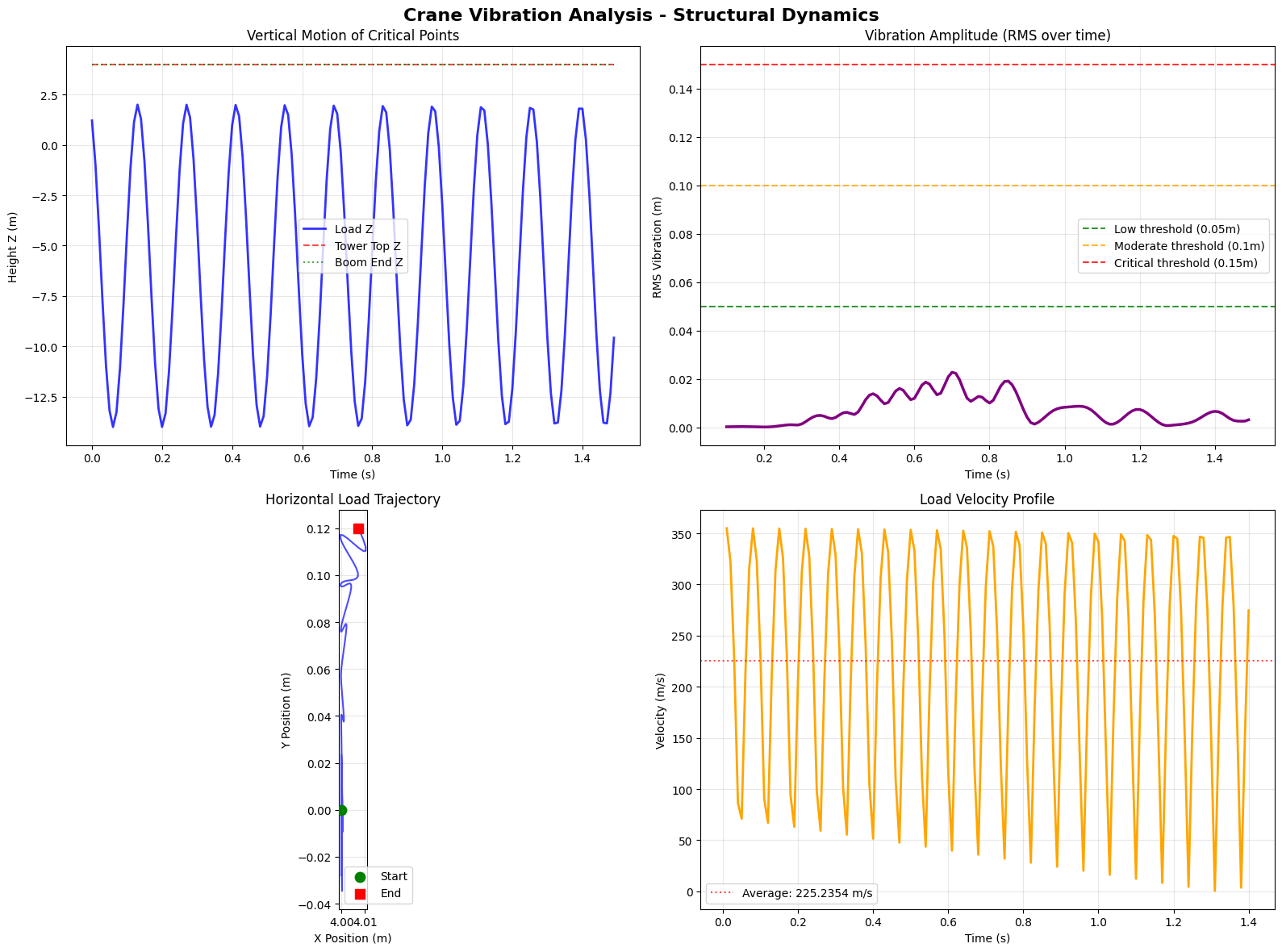
======================================================================
VIBRATION ANALYSIS - STRUCTURAL ASSESSMENT
======================================================================
Maximum vibration amplitude:    0.0227 m
Average vibration:              0.0069 m
Standard deviation:             0.0058 m

Vibration distribution (140 measurements):
  Low       (≤0.05m):   140 (100.0%)
  Moderate  (0.05-0.1m):   0 (  0.0%)
  High      (0.1-0.15m):   0 (  0.0%)
  Critical  (>0.15m):     0 (  0.0%)

Structural stability: EXCELLENT
Safety factor: Very high

Maximum velocity:        354.9622 m/s
Average velocity:        225.2354 m/s

Load motion range:
  X-direction: 0.0109 m
  Y-direction: 0.1545 m
  Z-direction: 16.0073 m

STRUCTURAL RECOMMENDATIONS:
   Structure shows excellent stability
   No special measures required
======================================================================